Wednesday, February 27, 2013

All-Decade Team

It occurred to me that I will run out of teams to post on this 1967 card blog before my other 3 football blogs, not that there were fewer teams, but because I don’t have many 1967 Topps AFL cards. So, I’m going to occasionally mix in other football topics on this 1967 blog. Today is one of those times…

For the above-stated reason, and to mix it up a little bit, today I’m posting one person’s opinion of the All-Decade team. By “decade”, I don’t mean the 1960s, but rather, the ten-year period that included Super Bowls I – X. (So that no math skills are required to follow along, that’s 1966-75.) This is a logical arbitrary starting point, and it saves me from explaining that I don’t own a card of Jim Brown (who retired after the 1965 season).

This All-Decade team consists of 48 players. Generally, I selected twice the number of players at each position than what is found in a starting lineup. An exception is kickers and punters. They get 1 slot between them, because after all, didn’t a wise man once say “They aren’t really football players”? Secondly, aside from Ray Guy, there probably isn’t another punter you could refer to using the “All-“ prefix. Thirdly, I like symmetry, and adding more kickers/punters would spoil my “multiples of 4” layout.

What criteria did I use? I’ll tell you that no stats websites or card backs were looked at to come up with the selections. Nor was “how many championships did he win” given primary consideration. This was based purely on my recollections, the player’s reputation, (perceived or actual) player’s and team accomplishments, and just a gut feeling.

Oh, one other thing: the player’s card needed to be in my collection, and (sorry, 49ers’ 1972 center Forrest Blue) it has to be a vertical card, because, you know, the whole symmetry thing.

Here now is the All-Decade team, arranged by position. Feel free to agree, disagree, reminisce, or offer up your own selections for the 1966-75 time period.


Offense:

Defense:

Some observations:

1. No Eagles :(
I knew Bob Brown was going to be a slam dunk to make this team, but I can't find my all-years Eagles binder, so here he is as a Ram.

2. I also can't find my 1973 binder, so Chiefs' guard Ed Budde and Colts' linebacker Ted Hendricks were late scratches.

3. I couldn't decide between DTs Joe Greene and Alan Page, so they're both here, with Page occupying the spare slot on the middle linebacker row (which was going to be a punter's only shot to make this team.)

4. Merlin Olsen appears to be saying "I'm gonna get you, Brodie!"

5. Re-capping players per team:

6 - Packers
5 - Chiefs, Rams
4 - Cowboys, Raiders, Dolphins, Vikings
3 - Colts, Bears
2 - Redskins, Browns, Chargers
1 - Steelers, Oilers, Broncos, Lions
0 - 10 teams


Let the debating begin!

.

Monday, January 2, 2012

Pittsburgh Steelers

Here are the 1967 Steelers. Although in the NFL since 1933, they wouldn't become a factor until the 1970s. Prior to 1972, the Steelers won as many as 8 games only twice. Beginning in '72, they would win 8 straight division titles and 4 Super Bowls. I had the misfortune of living in the Pittsburgh area in the mid-1970s. I recognized that they were a great team, but I didn't need to hear about it 24/7.

Among the players below, only Ben McGee would remain into the 1970s, and he retired before the team's Super Bowl years. I had all these cards in 1967 except for Willie Asbury, Roy Jefferson, and Gary Ballman.


Steelers Team - The team finished 5-8-1 in 1966, and further slid to 4-9-1 in 1967. They continued to regress for 2 more seasons until Chuck Noll turned it around in his 2nd season as coach.


Bill Nelsen - Nelsen was drafted by the Steelers in 1963, and played 5 seasons with the team, but was only the fulltime starter in 1965. He moved on the the Browns in 1968, playing 4 seasons as the starting QB before wrapping up his career in 1973 as the backup to Mike Phipps.

Willie Asbury - Asbury had a 3-year career with the Steelers from 1966-68, and was the starting fullback for his first 2 seasons.


Roy Jefferson - Roy was a 2nd-round pick for the Steelers and Chargers in 1965. He played 5 seasons in Pittsburgh and 1 with the Colts, then played 6 seasons with the Redskins from 1971-76. He was a 3-time Pro Bowler.


Gary Ballman - Ballman was drafted in 1962, and was the Steelers' starting split end from 1963-66. A last-minute note on the back of this card says he was traded to the Eagles in March 1967 (for fullback Earl Gros). After 2 seasons as the Eagles' starting split end, he moved to tight end in 1969 (after Mike Ditka's departure) and was the starter through the 1971 season. He was an Eagles' reserve in 1972 and finished his career in 1973 with the Giants and Vikings.


John Hilton - A 6th-round pick for the Lions in 1964, John didn't play that season, but was the Steelers' starting tight end every season from 1965-69. He was also the Packers' starting tight end in 1970, and played with the Vikings and Lions from 1971-73.


Mike Clark - Clark kicked for the Eagles (1963), Steelers (1964-67), and Cowboys (1968-71, 73). He led the NFL in extra points in 1968 and 1971.

John Baker - Baker was the Rams' 5th-round pick in 1958. After 4 seasons in Los Angeles, he was the Eagles' starting left defensive end in 1962, and joined the Steelers in 1963. Starting at right defensive end from 1963-65, he was a backup for the Steelers from 1966-67 before ending his career in 1968 with the Lions.


Ben McGee - Ben was drafted by the Steelers in 1964 and was a starting defensive end for his first 7 seasons - 4 on the left side, before moving to right end in 1968. In 1971 he moved to right tackle to make room for rookie Dwight White. McGee retired after the 1972 season, and was replaced by Ernie Holmes.


Riley Gunnels - Riley was drafted by the Steelers in 1959, but didn't play that season. He spent the next 5 seasons with the Eagles, starting at left defensive tackle in '62 and '63, before returning to the Steelers for 1965 and 1966. He retired after the 1966 season.


Brady Keys - Keys was the Steelers' starting right cornerback and return man for his 1st 6 seasons (1961-66). He split the 1967 season between the Steelers and Vikings, and ended his career in 1968 with the Cardinals.


Steelers Logo - Yes, the Steelers were in a rebuilding program, but apparently the wrong builders were hired. Once Chuck Noll arrived in 1969, the serious rebuilding started, and they were winning division championships starting in Noll's 4th season.


Also check out the 1968 and 1972 Steelers.


Next time: St. Louis Cardinals
.

Saturday, January 8, 2011

Philadelphia Eagles

Here are your 1967 Philadelphia Eagles. Two of these players were gone before the 1967 season. I got the Timmy Brown and Earl Gros cards a few years ago, but had all the rest in 1967. Most of them are heavily scuffed from playing with them back in the day.


#133 Eagles Team - In 1966, the Eagles finished 9-5, tied with Cleveland for 2nd place (behind Dallas) in the 8-team NFL East. In 1967, they plummeted to 6-7-1, but still finished 2nd behind Dallas. (In 1967, the NFL re-aligned into four 4-team divisions.) Maybe if they hadn't lost their top 2 rushers from 1966 (Timmy Brown (injury) and Earl Gros (trade)), along with the retirement of 1966 leading receiver Pete Retzlaff, things would have been different.


#142 Norm Snead - Snead was the Redskins' #1 pick (2nd overall) in 1961. After starting every game for the Skins for 3 seasons, Norm was traded to the Eagles for Sonny Jurgensen. He was the Eagles' starting QB for the next 7 seasons, before being run out of town following the 1970 season. Poor Norm - while Jurgensen led the NFL in passing yards 5 times and TDs twice, all Snead managed to do was lead the NFL in interceptions 5 times. After playing 1971 as the Vikings' backup, Snead was the Giants' starting QB in 1972, and played the next 4 seasons as a backup for the Giants and 49ers.


#136 Timmy Brown - Brown was drafted by the Packers in 1959, but only played in 1 game. Moving to Philadelphia for 1960, he spent 2 seasons as their return man, and was the starting halfback from 1962-66, while still returning punts and kicks. His playing time was severely decreased in 1967 (injury?). After the season he was traded to the Colts for DB Alvin Haymond. Brown retired after 1 season in Baltimore and became an actor. He appeared in both the M*A*S*H movie and TV show.


#137 Earl Gros - Earl was the Packers' #1 pick in the 1962 draft, but with Jim Taylor around, he was rarely used. Gros was the Eagles' starting fullback from 1964-66, then was traded in March 1967 to the Steelers for receiver Gary Ballman. After 3 seasons in Pittsburgh (the last 2 as starting fullback), he wrapped up his career in 1970 with the Saints.

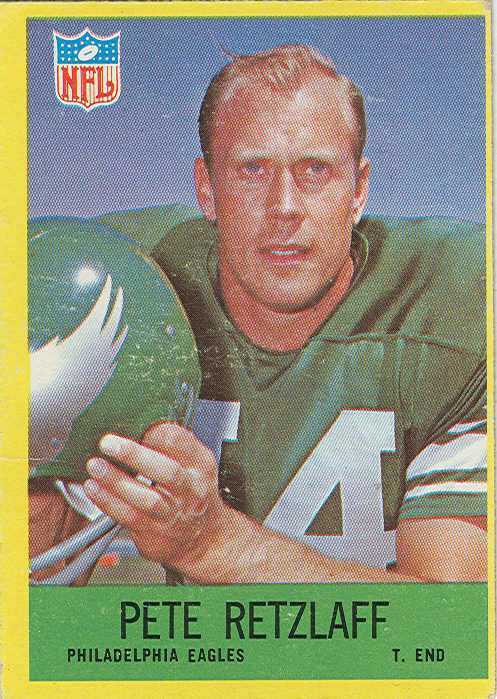
#140 Pete Retzlaff - Pete was one of the few bright spots on the Eagles' roster during this time period. Unfortunately, he retired after the 1966 season. Retzlaff was drafted by the Lions in 1953, but didn't make the team. After 2 years in the army, he joined the Eagles in 1956, and starred for 11 seasons, the first seven as a flanker and split end, before switching to tight end in 1963. Pete was a 5-time Pro Bowler. He became the Eagles' general manager in 1969 after the 1968 housecleaning that included the owner, GM/coach, and any chance to select O.J. Simpson as the #1 draft pick. (see comments under Leroy Keyes here)


#143 Jim Skaggs - Skaggs played his entire career (1963-72) with the Eagles. He was the team's starting right guard from 1965-70, although he missed the entire 1968 season (and part of 1969 and 1971) with injuries.


#135 Bob Brown - Bob Brown was probably the Eagle's best player during his time with the team. Bob was the Eagles' #1 pick (2nd overall) in the 1964 draft. In his 5 seasons with the Eagles, he started every game at right offensive tackle, except for missing 6 games in 1968 due to injury. Following the 1968 season, the Eagles hired their former tight end Pete Retzlaff as GM. Brown decided he wasn't going to play for the team with Retzlaff in charge, and demanded a trade. Bob was shipped to the Rams for WR Harold Jackson and others, starting every game in his 2 seasons with LA, while making the Pro Bowl in both years. His final 3 seasons (1971-73) were spent as the Oakland Raiders' starting right tackle. In all, he made 6 Pro Bowls and was inducted into the Hall of Fame in 2004.


#134 Sam Baker - Baker was drafted by the Rams in 1952, but began his career in 1953 with the Redskins. Always a kicker and punter, early on he also played fullback (mostly in 1953 and 1956). After playing 5 seasons in Washington (1953, 56-59), he moved on to Cleveland (60-61) and Dallas (62-63), before playing his last 6 seasons with the Eagles. In his final season of 1969, he was limited to kicking only, as rookie safety Bill Bradley took over the punting chores. Baker was a 4-time Pro Bowler ('56, '63, '64, '68).


#139 Floyd Peters - Floyd played in the NFL for 12 seasons (1959-70), and was a starting defensive tackle every year except 1959 and 1968. He played 4 seasons with the Browns, then played one season with the Lions in 1963. That year he switched to the left side, where he remained for the rest of his career. His 5 seasons with the Eagles (1964-69) included 3 trips to the Pro Bowl. Peters finished his career in 1970 as a starter with the Redskins.


#138 Dave Lloyd - Lloyd's career path follows that of Floyd Peters. His first 3 seasons (1959-61) were as a member of the Cleveland Browns, followed by one season with the Lions, before joining the Eagles for the bulk of his career. Dave was the Eagles' starting middle linebacker from 1963 until midway into his final season of 1970. After he was replaced at MLB by former DE Tim Rossovich, Lloyd kept busy for the rest of the year by kicking off (leaving the field goals and PAT to rookie Mark Moseley). Dave made the Pro Bowl in 1969, his final season as a regular starter.


#141 Joe Scarpati - Joe was drafted by the Boston Patriots in 1964, but chose to sign as a free agent with the Eagles. After starting at strong safety during his rookie season, Scarpati was the Eagles' starting free safety from 1965-69. In 1968, he had 8 interceptions for a league-leading 182 yards. Traded to New Orleans after the 1969 season, he was the Saints' starting free safety in 1970, before returning to the Eagles for 1971. A training camp injury that year ended his career.


#144 Eagles Logo - Here's the classic Eagles' logo on Kelly Green - much better than the marketing-induced logo and colors concocted by the Jeff Lurie regime.


Also check out the 1971 and 1972 Eagles.


Next time: Pittsburgh Steelers
.

Wednesday, June 23, 2010

New York Giants

Seven of the 10 Giants are pictured in helmets. In fact, of all the players in the 1967 set, only 12 are wearing helmets: 7 Giants, 2 Saints (pictured in their 1966 Giants' uniforms), and 3 Colts.

I had all these Giants cards in 1967 except for Spider Lockhart.


#109 Giants Team - The back of this card tells us that "After a spectacular rise from the cellar in '64, to a 2nd place tie in '65, the Giants fell to the cellar again in '66 with a 1-12-1 record".
With a new QB on board for 1967, they would soar to a 7-7 record, finishing 2nd in their division.


#114 Tom Kennedy - I always thought it was strange that Philly Gum chose Tom Kennedy for their 1967 Giants' QB. Earl Morrall began the previous season as the starter, but after injuries sidelined him, he was replaced by backup Gary Wood, with Kennedy being called up from the Continental League as a backup. Wood was then lost to the Saints in the expansion draft, so the obvious choice for this card would have been Morrall. No matter, in March 1967 the Giants traded for Fran Tarkenton, making Morrall and Kennedy irrelevant. Kennedy's only NFL action was in 1966.


#112 Allen Jacobs - Allen's NFL career consisted of 1 year with the Packers (1965), and 2 years with the Giants. He played 34 games, starting none.

#116 Joe Morrison - Morrison was the Giants' 3rd-round pick in 1959, and played his entire career with the Giants (1959-72). Usually a running back or flanker, he also played defensive back during his career.

#113 Homer Jones - Homer played 6 seasons (1964-69) with the Giants before finishing his career in 1970 with the Browns. He was the Giants' starting split end from 1966-69.


#119 Aaron Thomas - Thomas was drafted by the 49ers in 1961, and was their starting split end as a rookie. He joined the Giants early in the 1962 season, and remained with them until retiring after the 1970 season. He was the starting tight end from 1964-68.


#117 Francis Peay - Peay was New York's #1 pick in the 1966 draft. After only 2 seasons with the Giants he moved on to the Packers, where he was their starting left offensive tackle for several years, before finishing his career with the Chiefs from 1973-74.


#118 Jeff Smith - Who's picking the subjects for these cards? Smith was a 10th-round pick in 1966, played 14 games for the Giants, and never played in the NFL again.


#111 Clarence Childs - Childs played for the Giants from 1964-1967, and the Bears in 1968. Primarily a kick returner, he was also the Giants' starting right cornerback in 1966. As a rookie, he returned a kickoff 100 yards for a touchdown.


#115 "Spider" Lockhart - Lockhart was the Giants' 13th-round pick in 1965, and played his entire career (1965-75) with the Giants. After serving as the starting left cornerback for his 1st 2 seasons, he was the team's starting free safety for his remaining 9 seasons. He also returned punts (mostly from 1966-70), and punted from 1965-68.


#110 Henry Carr - Carr was drafted by the Giants in 1965, and after 2 seasons as a starting safety, he concluded his NFL career in 1967 as the Giants' starting right cornerback. A track star at Arizona State, Henry won 2 gold medals at the 1964 Olympics in Tokyo.


#120 Giants Logo - "The players try hard. The coach tries hard. Perhaps the fans should try harder." Whaaa? This is the funniest comment I've ever seen on the back of a sports trading card!


Next time: Philadelphia Eagles


Also check out the 1972 Giants.

.

Tuesday, May 4, 2010

Minnesota Vikings

Here are the 1967 Vikings. All but Dale Hackbart are pictured in their classic purple jerseys. I like these late-1960s jerseys much better than the early 1970s Vikings' jerseys, which look too much like New York Giants' jerseys. I think my 3 favorite NFL jerseys are the Packers (green w/gold arm stripes), Vikings (purple w/white arm stripes and gold edging around the numbers), and the Steelers (black w/gold arm stripes). I also like the Miami Dolphins' jerseys (teal with orange trim).

I got all of these cards back in the day except for Bill Brown.


#97 Vikings Team - The Vikings finished 1966 with a 4-9-1 record - last in the West. After trading QB Fran Tarkenton in the off-season, they finished 3-8-3 in 1967, the first of Joe Kapp's 3 seasons as the Vikings' QB.

#106 Fran Tarkenton - Tarkenton was the Vikings' QB from their inception in 1961 through the 1966 season, then again from 1972-78. In between, he spent 5 seasons with the Giants. He was inducted into the Hall of Fame in 1986. (The back of this card states that he was traded to the Giants on March 7, 1967.)


#104 Tommy Mason - Mason was the Vikings' #1 pick (1st overall) in the 1961 draft (the team's 1st season). He played 6 seasons with the Vikings and 3 with the Rams before wrapping up his career with the Redskins in 1971. In the 1970s he was married to former Olympic gymnast Cathy Rigby.


#99 Bill Brown - Bill was the Bears' 2nd-round pick in 1961. After 1 season in Chicago, he spent the rest of his career as the Vikings fullback, until retiring after the 1974 season. He led the NFL with 251 rushing attempts in 1966.


#101 Paul Flatley - Paul was the Vikings' split end from 1963 to 1967, then played 3 more seasons with the Falcons.


#107 Mick Tingelhoff - Mick played his entire career (1962-78) with the Vikings, starting every game (240) at center during that time. He was a 6-time Pro Bowler.


#105 Milt Sunde - Sunde (SUN-dee) played his entire career (1964-74) with the Vikings, and was a starter from 1965-73. Early on, he was the team's starting left guard before moving to the right side in 1968.

#98 Grady Alderman - Grady was drafted by the Lions in 1960, and joined the expansion Vikings in 1961. He was their starting left offensive tackle from 1961-73, missing only 2 games during that time span. Alderman retired after the 1974 season.


#100 Fred Cox - Fred was drafted by the Cleveland Browns and New York Titans (Jets) in 1961, but did not play until he joined the Vikings in 1963. He kicked for the Vikings from 1963-77, and also punted (70 times) during his rookie season.


#103 Jim Marshall - Marshall started every game during his 20-year career (282 regular-season games) which included 1960 with the Browns and 1961-79 with the Vikings. He was the starting right defensive end in every season except 1961, when he played left defensive end. (The back of this card mercilessly states "He will always be remembered for picking up a 49er fumble and going 66 yards to the wrong end zone for a SF safety.")


#102 Dale Hackbart - Hackbart was drafted by the Packers in 1960. After a full season in 1960 and 2 games in 1961, he was traded to the Redskins, where he was the starting free safety from 1961-63. After 2 seasons with the Canadian League's Winnipeg Blue Bombers, Dale played for the Vikings from 1966-70, starting at free safety for the 1st two seasons. He later played for the Cardinals (1971-72) and the Broncos (1973).


#108 Vikings Logo - The Vikings joined the NFL in 1961, one season after the Dallas Cowboys. Soon, the Falcons (1966) and Saints (1967) would increase the NFL to 16 teams.


Also check out the 1972 Vikings.


Next time: New York Giants
.